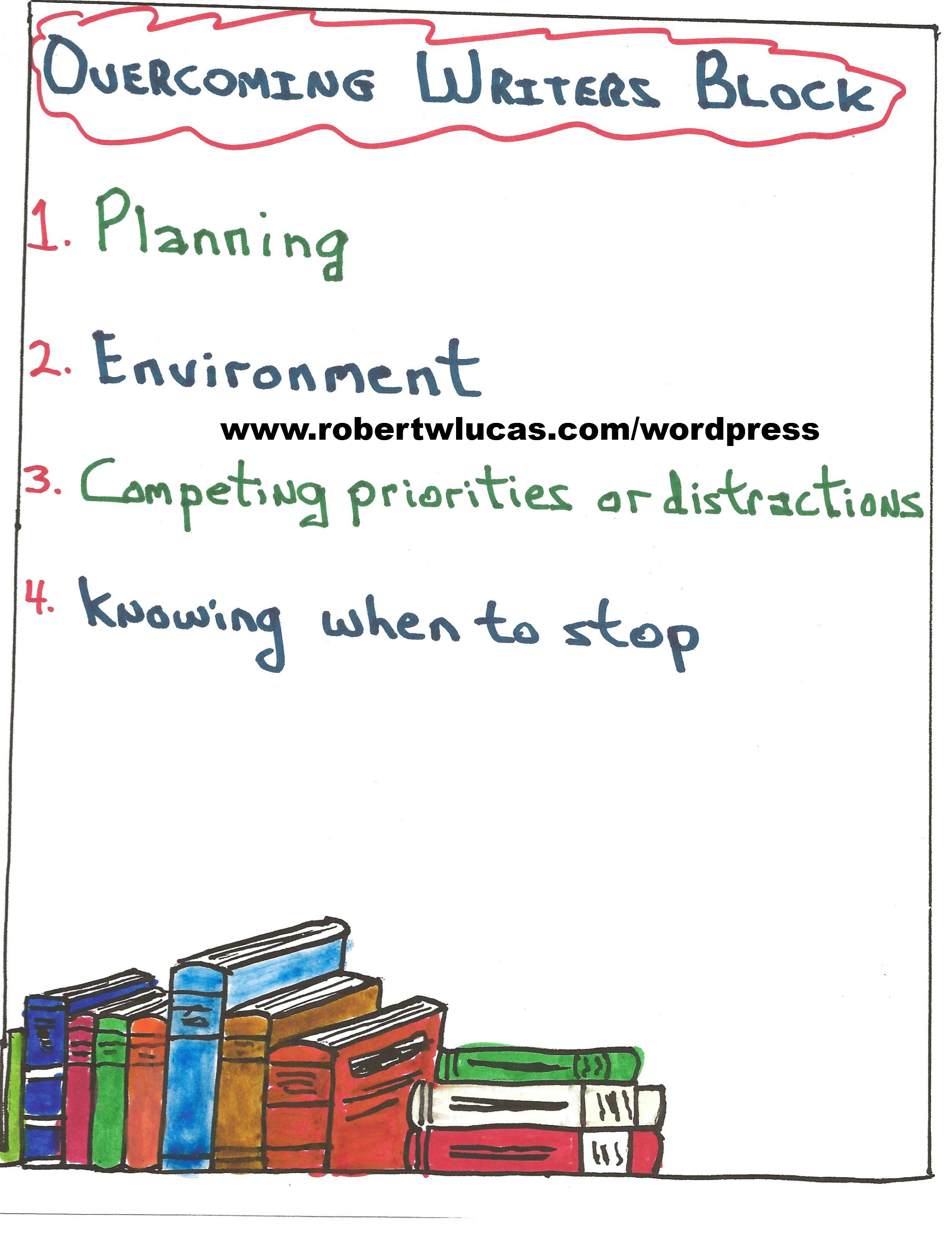
 Most writers that I know have encountered what has been termed “writer’s block” at some point in their career. This often occurs for a variety of reasons but typically revolves around four factors: (1) Planning, (2) Environment, (3) Competing priorities or distractions, and (4) Knowing when to stop.
Planning. Like any other successful venture in life, it is crucial to have a plan if you want to succeed as an author. This starts with doing some topic research, gathering information, ideas and materials together, and putting together an outline of what you want to include in your finished book or article.
While planning may seem like a common sense or simple thing to do, many authors do not take the time to organize their thoughts, storyline and materials prior to sitting down to write. The result is that their mind wanders or they continually stop to gather ideas and materials as they write, which disrupts their creative process.
Environment. If you have a separate office or place to isolate yourself from the world without distractions, you are fortunate. For most writers, their “space” is often a separate room in their home. If this is your situation, try to set up a separate room used exclusively for writing or that does not have high traffic to or through it.
Additionally, make sure that you have all the materials you will need (e.g. computer, copier/scanner, paper, pencils/pens, stapler, folders, tape, and anything else you normally use) before you go in to write. This will save you having to stop writing to go find the items or make a trip to the office supply store.
Competing priorities or distractions. If you must write at home, you are likely to be deluged with ringing doorbells, telephones, children and spouses or significant others interrupting them, or myriad other things competing for your attention as you write.
If possible, find a time to write where these issues are not as common (e.g. early in the morning or later at night, depending on your circadian rhythm. Also, set some guidelines on interruptions or times when you are available and get others to agree to respect them.
Knowing when to stop. Most writers are latent perfectionists who want their work to be the best it can be. As a result, they tend to try to edit and rewrite as they go. Once they have completed a manuscript or article; they continue to edit it into infinity.
I find that rather than interrupting my flow of thoughts, I try to get my words into the computer and then go back to do edits. After I have edited once or twice, I put the document aside for a day or so and work on other projects. I then come back to the original work with a fresh pair of eyes and often catch small typos or find text that needs a bit of adjusting. Try this to see if it works for you.
My personal belief is that writing should come from the heart. You should enjoy the process and love the creativity of the process and the fulfillment that you get from seeing the final work in print. Unfortunately, writing a book or article can be an excruciating experience for some people. If that is the case for you, maybe you should consider getting a ghostwriter and pouring your story out to them to write.
Whatever route you take to getting your ideas in print, take the time to create a roadmap of what you want to accomplish and then set out on that journey to creativity.